library(tidyverse)
library(wesanderson)
library(patchwork)
library(gt)
library(gtExtras)
source("functions_features.R")
source("functions_plotting.R")

# Shared gt theme so every table matches the blog's typography and palette
# (header in the heading navy #1D323E, IBM Plex fonts, subtle striping, and
# tabular/monospaced figures so numeric columns line up).
gt_theme_penalties <- function(gt_tbl) {
  out <- gt_tbl |>
    gt::opt_table_font(font = "IBM Plex Sans") |>
    gt::tab_options(
      table.width = gt::pct(100),
      table.font.size = gt::px(14),
      table.border.top.style = "none",
      table.border.bottom.color = "#d9dee1",
      heading.align = "left",
      heading.title.font.size = gt::px(15),
      heading.subtitle.font.size = gt::px(12.5),
      column_labels.background.color = "#1D323E",
      column_labels.font.weight = "bold",
      column_labels.font.size = gt::px(12.5),
      column_labels.border.bottom.style = "none",
      row.striping.background_color = "#f3f5f6",
      table_body.hlines.style = "none",
      table_body.border.bottom.color = "#d9dee1",
      data_row.padding = gt::px(6),
      source_notes.font.size = gt::px(11),
      source_notes.padding = gt::px(6)
    ) |>
    gt::opt_row_striping() |>
    gt::tab_style(
      style = gt::cell_text(color = "white"),
      locations = gt::cells_column_labels()
    ) |>
    gt::tab_style(
      style = gt::cell_text(font = "IBM Plex Mono"),
      locations = gt::cells_body(columns = dplyr::where(is.numeric))
    )

  # When a table has a spanner, the top header row is otherwise a navy "blob"
  # identical to the column labels below it. Give it a distinct, lighter look
  # (pale fill, dark normal-weight italic text) so the two header rows read as
  # caption-over-labels rather than one solid band. Guarded for spanner-less
  # tables, since this theme is applied to all of them.
  if (nrow(out[["_spanners"]]) > 0) {
    out <- out |>
      gt::tab_style(
        style = list(
          gt::cell_fill(color = "#eef2f4"),
          gt::cell_text(color = "#1D323E", weight = "normal", style = "italic", size = gt::px(11))
        ),
        locations = gt::cells_column_spanners()
      )
  }
  out
}

# Readable labels for the compact categorical codes used across the tables.
position_labels <- c(
  G = "Goalkeeper",
  D = "Defender",
  M = "Midfielder",
  A = "Attacking midfielder",
  F = "Forward",
  Sub = "Substitute"
)
label_position <- function(x) {
  dplyr::coalesce(unname(position_labels[as.character(x)]), as.character(x))
}

# Split camelCase foul codes and sentence-case them: "AerialFoul" -> "Aerial foul"
label_foul <- function(x) {
  x |>
    as.character() |>
    stringr::str_replace_all("(?<=[a-z])(?=[A-Z])", " ") |>
    stringr::str_to_sentence()
}

# "losing_3_plus" -> "Losing 3+", "equal" -> "Equal", "winning_1" -> "Winning 1"
label_game_state <- function(x) {
  x |>
    as.character() |>
    stringr::str_replace("_plus", "+") |>
    stringr::str_replace_all("_", " ") |>
    stringr::str_to_sentence()
}

# Shared builder for the placement (shot-zone-dominance) tables. Each row is a
# group (game state, phase, position, experience...) and the three columns
# Dominant/Centre/Non-dominant are that group's placement split, which always
# sums to 100%. Every one of these tables asks a *comparative* question -- "does
# the strong-side preference change ACROSS groups?" -- so the colour highlights
# differences DOWN each column, not the trivial within-row fact that the dominant
# side is biggest. Each zone column is shaded on a diverging scale centred on its
# own median (the "typical" group), reusing the doc's difference-plot palette
# (GrandBudapest2: pink = below typical, periwinkle = above). Centring on the
# median keeps a small, tiny-n outlier group from hijacking the whole scale.
placement_gradient_table <- function(data, group, group_label) {
  wide <- data |>
    dplyr::filter(!is.na(shot_zone_dominance)) |>
    dplyr::select(rowcat = {{ group }}, shot_zone_dominance, prop, prop_n_string) |>
    tidyr::pivot_wider(
      names_from = shot_zone_dominance,
      values_from = c(prop_n_string, prop)
    ) |>
    dplyr::rename(
      Dominant = prop_n_string_Dominant,
      Centre = prop_n_string_Centre,
      Non_dominant = prop_n_string_Non_dominant
    ) |>
    dplyr::relocate(Dominant, Centre, Non_dominant, .after = rowcat)

  tbl <- wide |>
    gt::gt() |>
    gt::tab_spanner(
      label = "Shot placement (share of penalties, n)",
      columns = c(Dominant, Centre, Non_dominant)
    ) |>
    gt::cols_label(
      rowcat = group_label,
      Dominant = "Dominant side",
      Centre = "Centre",
      Non_dominant = "Non-dominant side"
    )

  # Diverging shading, one column at a time: each zone centred on its own median
  # and scaled symmetrically to that column's largest deviation from it.
  for (z in c("Dominant", "Centre", "Non_dominant")) {
    pcol <- paste0("prop_", z)
    vals <- wide[[pcol]]
    med <- median(vals, na.rm = TRUE)
    spread <- max(abs(vals - med), na.rm = TRUE)
    if (is.finite(spread) && spread > 0) {
      tbl <- tbl |>
        gt::data_color(
          columns = dplyr::all_of(pcol),
          target_columns = dplyr::all_of(z),
          palette = c("#E6A0C4", "#F7F7F5", "#7294D4"),
          domain = c(med - spread, med + spread),
          na_color = "white"
        )
    }
  }

  source_note <- paste(
    "Cell colour compares groups down each column:",
    "periwinkle = leans on that zone more than the typical (median) group,",
    "pink = less. Read the share itself from the cell."
  )

  tbl |>
    gt::cols_hide(c(prop_Dominant, prop_Centre, prop_Non_dominant)) |>
    gt::sub_missing(missing_text = "–") |>
    gt::tab_source_note(source_note) |>
    gt_theme_penalties()
}

df <- nanoparquet::read_parquet(
  "data/penalties_ws.parquet"
) |>
  convert_opta_to_meters() |>
  add_features()

df_male <- df |> dplyr::filter(!is_female_league)

lighten <- function(color, amount = 0.55) {
  v <- col2rgb(color) / 255
  rgb(
    v[1] + (1 - v[1]) * amount,
    v[2] + (1 - v[2]) * amount,
    v[3] + (1 - v[3]) * amount
  )
}

# One base color per subgroup, shades generated within
base_colors <- c(
  "Men top 5 league" = "#046C9A", # Darjeeling2 navy
  "Men non top level league" = "#78B7C5", # Zissou sky blue (same family, lower tier)
  "Men other European league" = "#00A08A", # Darjeeling1 teal-green
  "Men league outside Europe" = "#D8B70A", # Cavalcanti gold
  "Men cup" = "#F98400", # Darjeeling1 orange
  "Men international club" = "#C93312", # Darjeeling2 brick red
  "Men international country" = "#9986A5", # IsleofDogs purple-gray
  "Women league" = "#F4B5BD", # Moonrise3 blush
  "Women international country" = "#7294D4" # GrandBudapest2 periwinkle
)

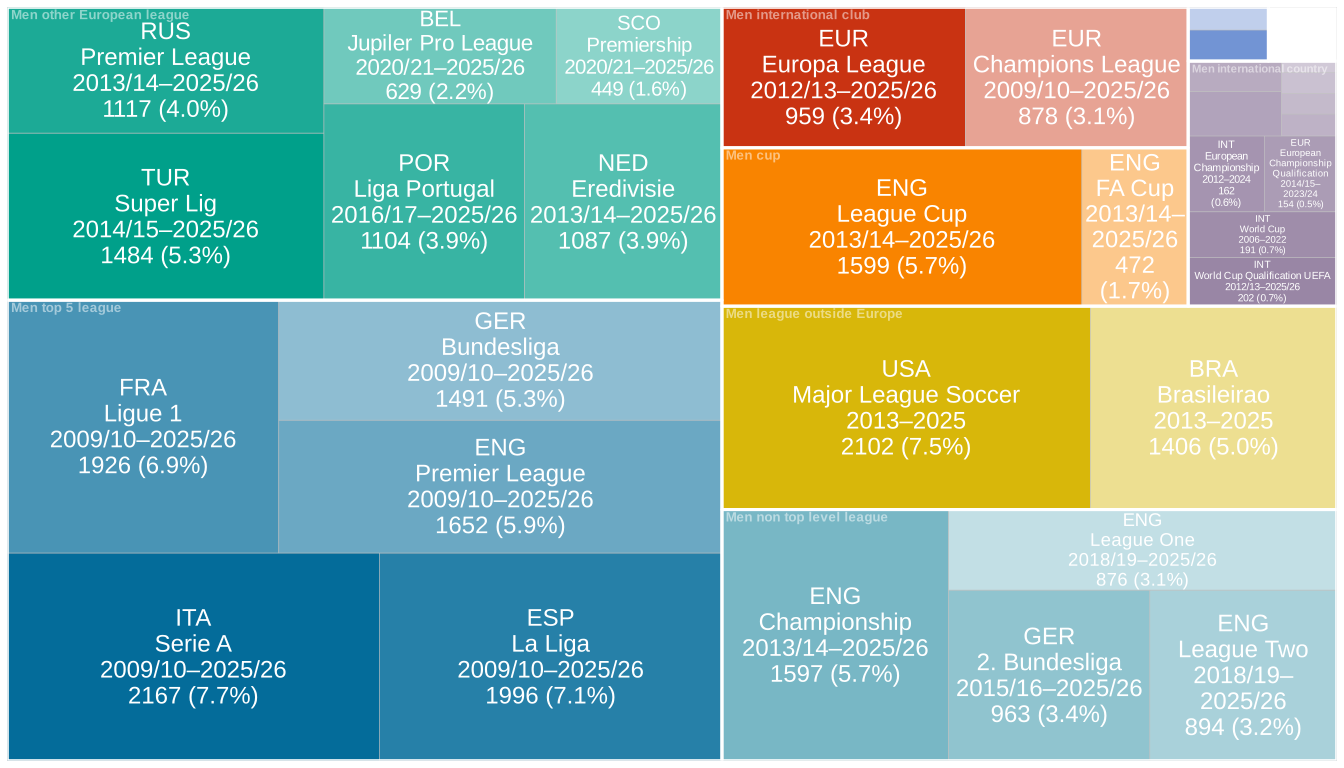
treemap_data <- df |>
  dplyr::group_by(is_female_league, competition_type_detailed, competition, season) |>
  dplyr::tally() |>
  dplyr::ungroup() |>
  dplyr::summarise(
    n = sum(n),
    season_min = min(season),
    season_max = max(season),
    .by = c(is_female_league, competition_type_detailed, competition)
  ) |>
  dplyr::mutate(
    prop = n / sum(n),
    label = paste0(
      stringr::str_replace(competition, "-", "\n"),
      "\n",
      season_min,
      "\u2013",
      season_max,
      "\n",
      n,
      " (",
      scales::percent(prop, accuracy = 0.1),
      ")"
    ),
    gender = dplyr::if_else(is_female_league, "Women", "Men"),
    subgroup = paste(gender, competition_type_detailed),
    comp_id = paste(gender, competition)
  ) |>
  dplyr::arrange(subgroup, dplyr::desc(n)) |>
  dplyr::mutate(rank_in_subgroup = dplyr::row_number(), .by = subgroup) |>
  dplyr::group_by(subgroup) |>
  dplyr::mutate(
    fill_color = colorRampPalette(
      c(base_colors[subgroup[1]], lighten(base_colors[subgroup[1]]))
    )(dplyr::n())[rank_in_subgroup]
  ) |>
  dplyr::ungroup()

treemap_data |>
  ggplot2::ggplot(ggplot2::aes(area = n, fill = comp_id, label = label, subgroup = subgroup)) +
  treemapify::geom_treemap() +
  treemapify::geom_treemap_subgroup_border(color = "white", size = 3) +
  treemapify::geom_treemap_subgroup_text(
    color = "white",
    alpha = 0.5,
    fontface = "bold",
    place = "topleft",
    grow = FALSE,
    size = 10
  ) +
  treemapify::geom_treemap_text(
    color = "white",
    place = "centre",
    grow = FALSE,
    reflow = TRUE,
    min.size = 6
  ) +
  ggplot2::scale_fill_manual(
    values = setNames(treemap_data$fill_color, treemap_data$comp_id),
    guide = "none"
  )